
Research Summary
-
Transition Out of School for Autistic Young People: An Umbrella Review
Norah’s first paper asks practitioners for two things in transitions out of school. To plan with, nor for autistic young people; and to measure success against what young people and families actually want. It is too easy for professionals to give too much value to cultural milestones (and metrics) like employment or independent living. The…
-
Language interventions for autistic people
Language interventions should enable autistic people to self advocate and engage with the world in a way that they wish. So these interventions should both work, and be meaningful. This research is the first community consultation focused on language interventions of autistic people. It shows that members of the autism community value language as crucial,…
-
Autistic educators’ views and experiences of inclusion and exclusion: How workplace culture shapes belonging
It is not all bleak; there are stories of autistic educators working in schools with inclusive cultures. Here they report having control and autonomy over their roles. They have the freedom and ability to create their own environments: ‘it was a very calming classroom. That was all part of the making it like that deliberately…
-

Report from the House of Lords Select Committee on the Autism Act 2009
The Autism Act (2009) is the UK law dedicated specifically to supporting autistic people. It makes the government regularly create a formal autism strategy, combined with statutory guidance for the NHS and local authorities. In theory, this ensures accountability and change. Before Parliament creates the 2026 Autism Strategy, the House of Lords Select Committee gathered…
-

Failure to Account for Psychiatric Symptoms: Implications for the Replicability and Generalisability of Psychological Science?
Good studies in psychology are generalisabile and replicable. That means that: the group of participants really should represent the general population and the results should be able to be done again with very similar results. But, results show that people who sign up for psychological studies typically don’t represent the general population, usually due to…
-
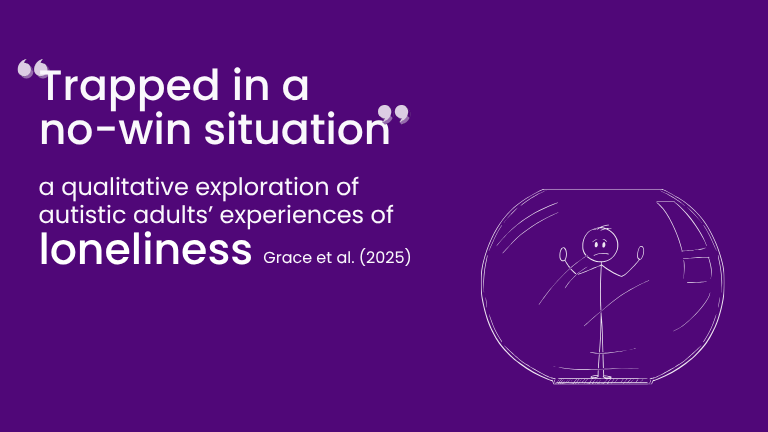
“Trapped in a no-win situation”
Loneliness is a common emotion experienced by many, but previous research indicates higher rates of loneliness within the autistic adult community. Led by Kana Grace, an autistic researcher, this study explores the lived experiences of a diverse group of over 200 autistic adults through an online survey. Each was asked a series of questions on…
-

Ten questions concerning autism and auditory accessibility in buildings.
Have you been distracted by the whine of an old fridge, the echo in a classroom, or the buzz of fluorescent lights? For autistic people, these sounds aren’t just small irritations, due to sensory hypersensitivity they can quickly build into something overwhelming. This paper explores how noise and the spaces we design can either support…
-

Identifying and supporting the needs of autistic children and young people
CRAE’s Mel Romualdez was part of a team of UCL academics who wrote the rapid evidence report on ‘Identifying and supporting the needs of children and young people with SEND’. They have put together a concise, up‑to‑date collection of what research says about how to spot needs early, provide good classroom support and work together…
-
Anti-social learning: The impact of language on mentalizing
Understanding others means being able to represent what they might be thinking or feeling. This is often called theory of mind. Recent work by Geoff and collegues suggests that before we can guess someone’s specific thoughts, we first build a general mental model of their mind.. This representation is placed in what they call mind-space:…
-
Mobilising Specialist Autism Mentoring in UK Universities
When entering higher education in the UK, students get offered a needs assessment through the Disabled Students Allowance. For autistic students, disclosure often results in the option for a Specialist Mentor (Autism). This study was built off a thematic analysis of diary entries completed by Specialist Mentors across the UK. A group of seven autistic…